Gamstop Scope and Non Gamstop Betting Regulations in the UK (2026)
 Available in GB
Table of Contents
- Defining the Scope of Gamstop and UK Casino Restrictions
- What the phrase can mean, and what it does not prove
- Why licence status and GAMSTOP status are not the same question
- Warning signs in the way a site talks about access
- If you are already self-excluded, blocked or worried about control
- Where to go next
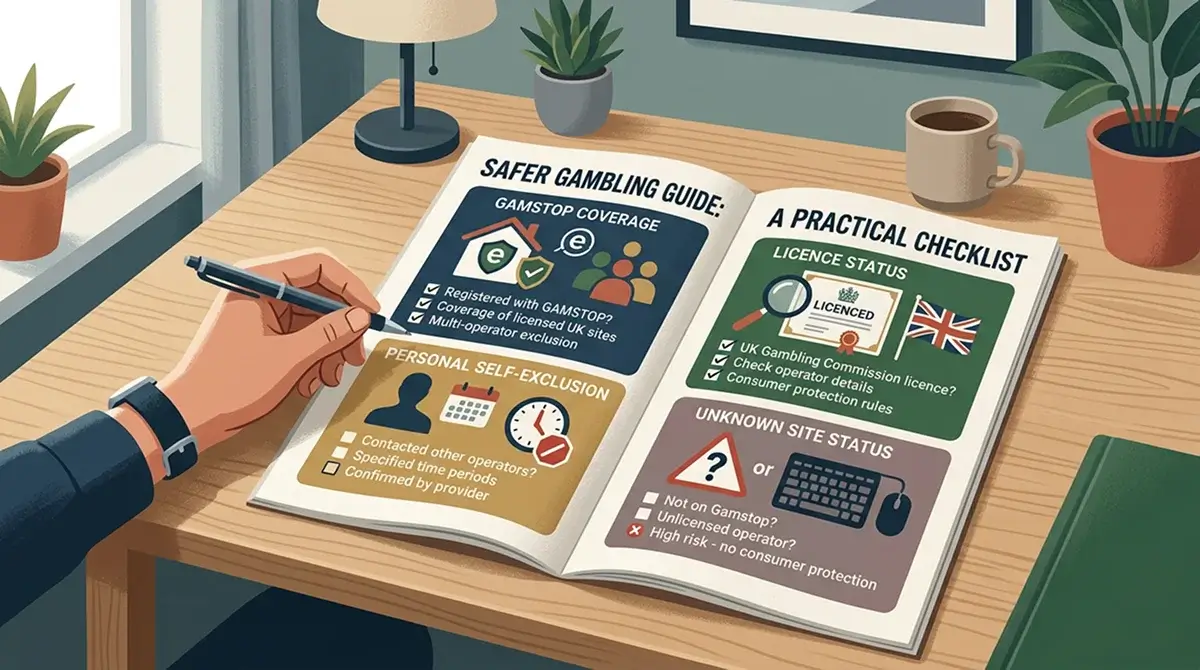
Players who bypass the scheme often regret it, so it is vital to know the next steps if you feel tempted to gamble while self-excluded.
Defining the Scope of Gamstop and UK Casino Restrictions
A list of sites can give a false feeling of certainty. The safer first question is narrower: what exactly is being claimed, and what does the claim prove? If the only claim is “not on GAMSTOP”, you still do not know whether the gambling business is licensed for Great Britain, whether the domain belongs to the company named in its terms, whether the account rules are fair and transparent, or whether the site has a clear complaints route.
It is also important not to turn self-exclusion into a technical puzzle. GAMSTOP’s own terms describe the tool as applying to participating gambling companies, and they also make clear that users should not try to work around exclusion measures. The most useful approach is to treat the phrase as a reason to check boundaries, not as a route to gambling while excluded.
Some readers arrive at the phrase after seeing marketing language. Others arrive because a payment was blocked, an account was closed, a verification check was requested, or a self-exclusion has started to feel inconvenient. Those situations are very different. The same words can point to curiosity, a money decision, a licensing question or a moment of risk. That is why this page focuses only on meaning and scope, while more detailed checks sit on separate pages.
What the phrase can mean, and what it does not prove
| Wording or situation | What it can mean | What it does not prove |
|---|---|---|
| “Not on GAMSTOP” | The site may not be covered by the GAMSTOP self-exclusion system used by GB-licensed remote gambling companies. | It does not prove the site is safe, suitable, lawful for your situation, fairly run, or free from withdrawal problems. |
| GB licence claimed | A gambling business may say it is licensed in Great Britain, or may show a licence-style statement. | A badge or sentence does not replace checking the exact business, trading name and domain details in the official register. |
| No participation claim | A site may be outside the GAMSTOP network or may be making a broad marketing claim. | It does not explain the level of consumer protection, how complaints work, or how identity checks are handled. |
| You are self-excluded | Your own protection setting is active for the period you chose and cannot be cancelled during the minimum period. | It does not become safer because another site claims to be available. The protection is there because you chose a boundary. |
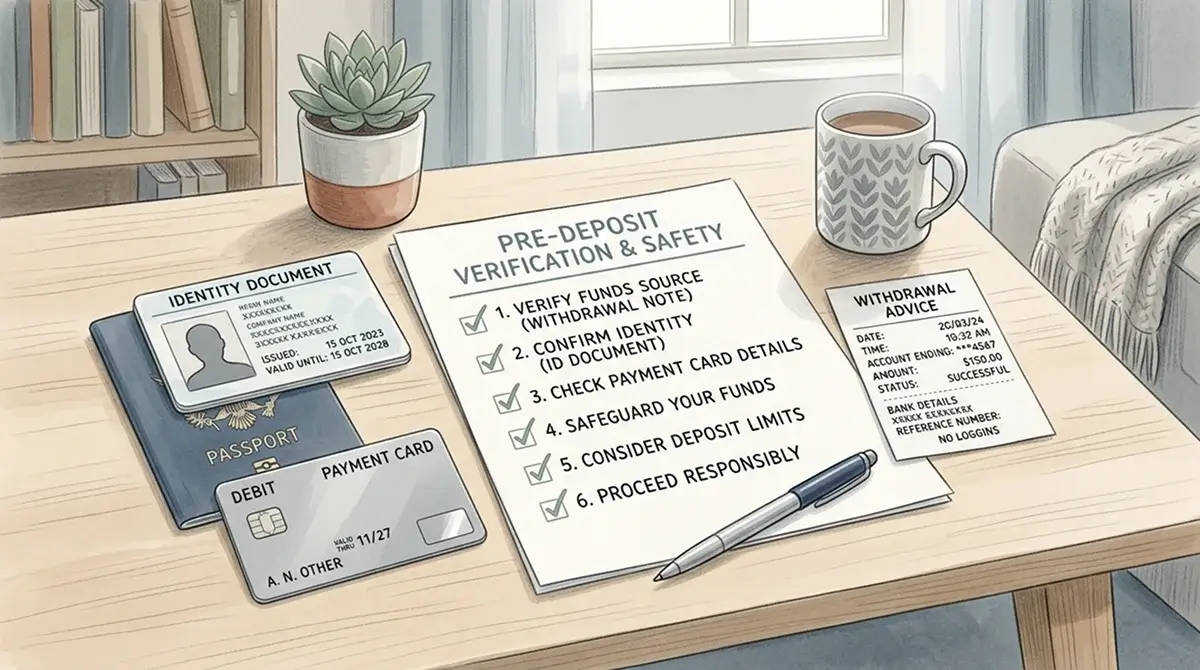
| Unknown site status | The most honest answer may be that the status is not yet clear from the information in front of you. | Unclear status is not a reason to deposit first and check later. |
Why licence status and GAMSTOP status are not the same question
GAMSTOP is tied to participating gambling companies in the Great Britain remote-gambling framework. Licence status is about whether a gambling business appears in the Gambling Commission’s official public information and what that status says. Those questions connect, but they are not identical in a reader’s real-world decision. A site can use confusing language, a domain can differ from the company name, and marketing text can be more confident than the terms below it.
The practical lesson is simple: do not treat “not on GAMSTOP” as a category with one answer. Treat it as a phrase that needs unpacking. If you are not self-excluded and you are considering any gambling site, the next step is to check a gambling business through official sources before thinking about deposits, bonuses or withdrawals. If you are already self-excluded, the next step is not a licence hunt; it is support, friction and protection.
This distinction avoids two common mistakes. The first is assuming that any site outside GAMSTOP is automatically illegal or automatically safe. A public guide should not make either claim about a specific site without a current official check. The second mistake is treating the phrase as a clever way to avoid a boundary. If a protection tool is active, the more useful question is how to keep the boundary working when the urge to gamble returns.
Warning signs in the way a site talks about access
The wording around access often tells you how the site wants you to think. Cautious wording explains licensing, account checks, payment restrictions, complaint routes and customer-fund information. Riskier wording pushes convenience while avoiding clear answers. Be especially careful with language that presents lack of identity checks, weak limits, payment blocks, self-exclusion gaps or alternative payment routes as attractions.
- Vague licence language: a logo, seal or short claim is not the same as current official status tied to the exact business and domain.
- Workaround language: text that treats self-exclusion, bank blocks or verification as things to get around is not acting in your best interest.
- No clear account owner: if the terms do not clearly connect the trading name, company name and domain, you have less to rely on if something goes wrong.
- Pressure to deposit quickly: urgency around bonuses or access can distract from reading withdrawal, fund-protection and complaints information.
- No-verification language: in this topic, a lack of age or identity checks should be treated as a warning sign, not as a benefit.
None of those points requires naming a casino or ranking sites. They are decision checks that protect the reader from relying on slogans. If a claim is unclear, the safest practical answer is to pause and check official status before money is involved.
If you are already self-excluded, blocked or worried about control
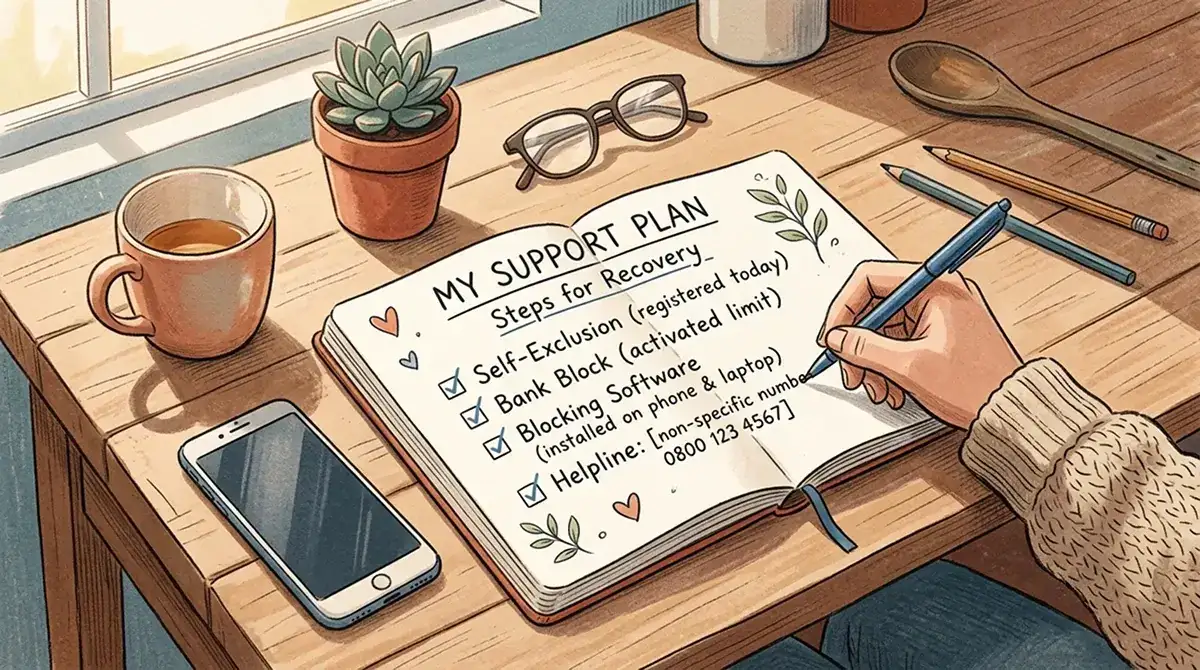
If you are reading because GAMSTOP, a bank block or another tool has stopped you from gambling, the protective meaning is more important than the technical meaning. Self-exclusion can feel frustrating in a heated moment, especially after a loss or when you feel you are close to winning money back. That feeling does not make the boundary less useful. It usually means the boundary is doing the job it was set up to do.
The Gambling Commission has described self-exclusion as most effective when it is combined with other blocking tools such as gambling blocking software and payment-card blocking. In plain terms, one layer may not be enough for everyone. Updating your registered details, keeping bank blocks in place, using blocking software, and talking to a trusted support service can create more friction between an urge and an action.
This page will not explain how to get around a protection you have chosen. A more helpful next step is to read safer next steps if you are self-excluded, especially if the phrase “not on GAMSTOP” came up while you were trying to gamble during an exclusion period.
Learn more about how these independent operators function by visiting our main sports betting not on Gamstop portal for comprehensive reviews.
Where to go next
Use the meaning page as a starting point, then move to the narrower question that matches your situation. If you are deciding whether a gambling business can be checked before depositing, use the official-check route. If you are trying to understand payment, ID or withdrawal terms, read those before moving any money. If the issue is control, temptation or a live self-exclusion, choose support over another gambling option.